
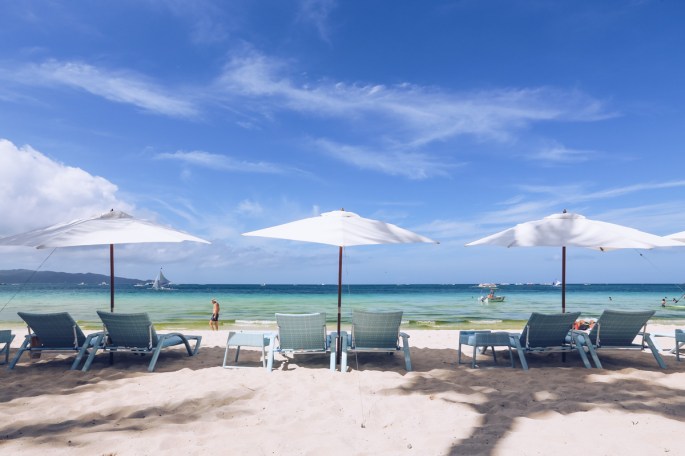
Powder soft white sand beaches that appear to stretch on into infinity. Crystal clear water perfect for diving (or just watching fish swim around your toes as you wade into the ocean). A buzzing nightlife with beach entertainment and nightclubs that keep the party going well into the wee hours of the morning. These things and more have had tourists flocking to Boracay since the early 1980’s. One of the Philippines’ most popular islands (there are over 7,000!), these days Boracay receives almost two million visitors a year. It’s understandable – I mean, everyone deserves to relax on an island paradise at least once in their lives, right? – but such a high level of tourism on such a small island has had some pretty major consequences for this popular destination, which we would quickly discover upon our own arrival around this time last year.
We visited Boracay in mid-March, hoping to spend the better part of a week doing absolutely nothing while surrounded by Boracay’s natural beauty. Due to some unforeseen circumstances, that’s not exactly what we got. (Keep reading for the details of what went wrong…and how you can avoid a similar situation!) To say we were disappointed would be an understatement, but luckily, we still found several ways to save our holiday, and discovered some pretty cool places in Boracay in the process. Armed with the knowledge we gained from our own mistakes, I’ve created this travel guide to Boracay to ensure YOUR first trip to Boracay goes off without a hitch. Keep reading for all of our best Boracay travel tips, plus advice on how to avoid the crowds!

WHEN TO VISIT BORACAY
If the Boracay experience you’re looking for involves cloudless blue skies and a calm, glassy sea, then you’ll want to time your trip during the dry season which typically runs from November to May. If cooler temperatures are also preferable, then stick with the months closer to the beginning of dry season. By March, temperatures often reach the high 90’s Fahrenheit/high 30’s Celsius. However, keep in mind that even in the dry season it’s not uncommon to experience some rain. Heavy all-day rain showers like what you might experience during rainy season are unlikely, though. What you’ll need to worry about during the dry season more than rain is the algae.


This was the main thing that nearly ruined our trip. That long stretch of White Beach with its glittering white sand next to the sparkling waters of the sea that features on nearly every postcard and advertisement for the island? Yeah, we never got to see it. (Or photograph it, which besides relaxing was the thing I was most looking forward to in Boracay.) The beach, and a fairly wide portion of the water next to it, was completely full of algae. So much that kids were even packing it like snowballs and having algae fights. I’ve never seen anything like it. A local guy we met tried to tell us it was a good thing. He was right…to an extent.
Algae blooms in Boracay are nature’s way of maintaining balance in the water. They were common on the island long before tourism boomed. But, and this is a big but, as tourism became bigger and bigger business in Boracay, the amount of algae in the water grew, as did the length of the season when it’s most common to see it. A massive influx of people on the island has caused nature to have to work much harder to maintain balance in the water (likely thanks to inadequate sewage infrastructure – yuck) and so instead of a normal amount of seasonal algae, sometimes you end up with mounds of it lining the beach and turning the water into an unnaturally warm, slimy mess.
So how to avoid it? It’s anyone’s guess when the algae will show up, but generally you won’t have to worry about it during the earlier months of dry season. It’s not uncommon for the algae to show up as early as February, but by March (when we visited) it’ll almost certainly be a feature in any photos you were hoping to get. Apparently, some years it’s worse than others, but personally, I wouldn’t risk it. If I had known about the algae problem, I absolutely would have booked our trip earlier in the dry season!

HOW TO GET TO BORACAY
There are essentially two ways to reach Boracay. One is quicker, but involves taking an extra flight. The other is often cheaper, but takes a little longer. We chose the second option, mostly because anytime I can reduce the amount of time I’m in an airplane, I opt for that.
THE QUICKEST WAY
Two airports serve visitors to Boracay. The closest one to the island is Caticlan Airport. If you go this route, you’ll most likely fly to Manila first and then catch a flight on to Caticlan. Your next step will depend on whether or not you’ve booked a transfer with your hotel in Boracay. If you have, they’ll handle all your transportation from here. If you haven’t, it’s quite easy to reach Boracay on your own. Just hop into one of the motor-tricycles waiting outside the airport and enjoy your short, 15-minute journey to Caticlan Jetty where you’ll then need to buy a ticket on one of the boats heading to Boracay’s Cagban Port. They leave frequently and it’ll take no longer than 15-20 minutes to reach the port. There will be vans and motor-tricycles waiting at the port to take you on to your hotel or resort.
THE CHEAPER WAY
The other airport serving Boracay is Kalibo. It’s a good deal further away than Caticlan, but if you’re okay with taking a 1.5 hour bus ride after your flight, it’s an excellent option. The roads are fine and if you go with a transfer service (more on that in a second), the journey is simple. We chose this option because there are direct flights from Singapore to Kalibo, and the fare was almost half what it would have been if we’d flown to Caticlan.
If you fly into Kalibo and have not arranged a transfer through your hotel, I recommend booking a transfer with Southwest Tours. We used them on our way to Boracay and again on our way back to the airport. Both times, the process couldn’t have been smoother. They took care of all parts of the journey for us – the bus to Caticlan Jetty, the boat to Cagban Port, and the van to our hotel – and the stated price included the extra fees all visitors are required to pay on arrival at Caticlan Jetty. Otherwise, there are taxis outside Kalibo airport that can take you to Caticlan Jetty, but be prepared, they will swarm you as you exit and you’ll likely need to haggle to get a good price.
THE EXTRA FEES
All visitors to Boracay are required to pay a terminal fee and an environmental fee upon arrival at Caticlan Jetty. On your return at the end of your trip, you’ll need to pay the terminal fee again, but not the environmental fee. Thankfully, the fees are small – 100 pesos for the terminal fee and 75 pesos for the environmental. (That’s like $2 and $1.50 USD.)
If you are traveling to the Philippines by air, you’ll also need to be aware of the fees charged by the airport you’re flying into and out of. For most people, your airport fees on arrival in the Philippines will be included in the price of your airfare. Airport fees on departure, however, will have to be paid in cash before you’ll be allowed into the airport terminal. In March of 2017, the fee at Kalibo airport was 700 pesos per person ($14 USD). Make sure you have enough cash on you at the end of your trip to completely cover this cost because they don’t take cards!


WHERE TO STAY IN BORACAY
While there are places to stay on other parts of the island, the vast majority of accommodation choices in Boracay are found on White Beach. Split into three different “stations”, hotels and resorts on White Beach come in a wide range of budget levels. Generally, Station 1 is where you’ll find most of the upscale boutique hotels and luxury resorts. The beach is wider here and the sand is softer than anywhere else along White Beach, but those perks come at a high price if you want to stay beachfront.
For more affordable options, you’ll want to head on down to Station 2 or 3. What you’re coming to Boracay for will ultimately determine which of these two stations will suit you best. If you’re here to party and meet other travelers, or you just like to stay as close as possible to all the action, Station 2 will be your best bet. If you’re after a peaceful, relaxing beach holiday, then it’s Station 3 all the way. Station 3 is the quietest area along White Beach, and if could do it all over again, this is where I would stay.
 Marybeth's Blog